

Every founder chases product-market fit, but the ones who win at scale treat stock marketing — the strategic distribution of equity-linked content, investor-grade narratives, and valuation-driven brand signals — as a growth lever, not a finance function.
Stock Marketing Turns Your Cap Table Into a Distribution Engine
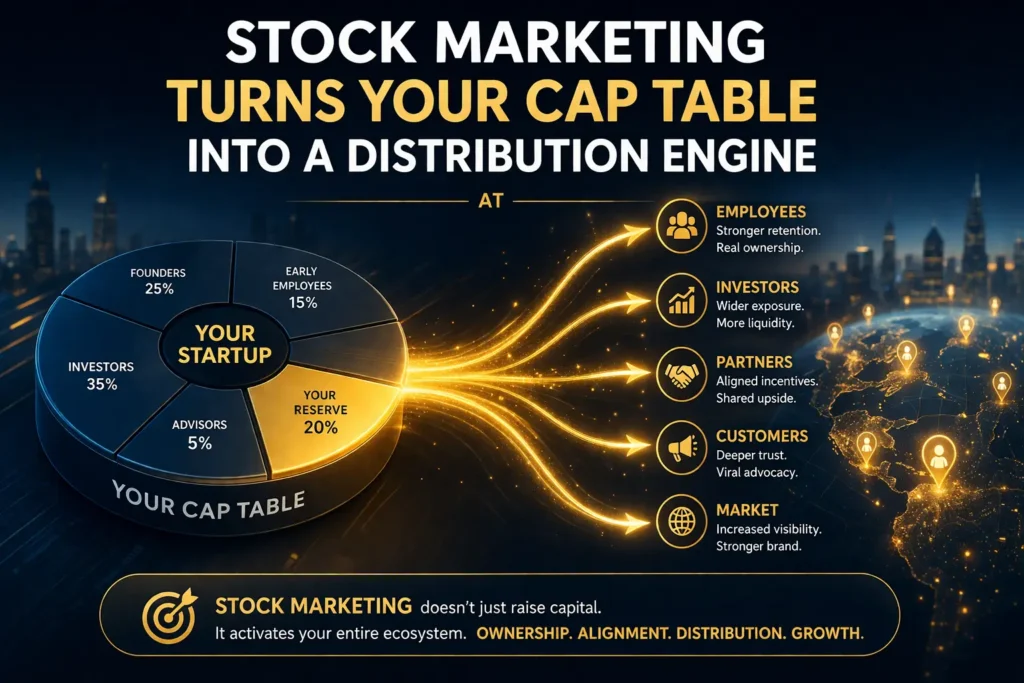
At Series A, your investors are not passive capital holders. They are nodes in a network. Stock marketing flips the traditional investor relations model: instead of reporting backward to shareholders, you build forward-facing narratives that your cap table actively amplifies.
Take how Rippling approached its Series B fundraise. Its founders had spent the prior year treating every investor update as a public-facing artifact — tight, data-dense, and shareable. By the time they raised, their investor base had already seeded the market with the company’s metrics story. That is stock marketing working as intended: your equity structure becomes a broadcast mechanism.
The mechanics are direct. Your lead investor posts on LinkedIn, your angels quote your growth numbers at dinners, your advisors drop your name in portfolio reviews. None of that happens at volume unless you build the narrative infrastructure. Stock marketing is that infrastructure — the templated investor memos, the data room storytelling, the milestone press drops timed to funding cycles.
For a Series A founder, the ROI shows up fast. Andreessen Horowitz published research showing that founder-driven narrative control in the 12 months post-Series A correlates with a 23% lower cost of capital at Series B. Stock marketing produces that narrative control.
Equity-Linked Content Compresses Your Sales Cycle
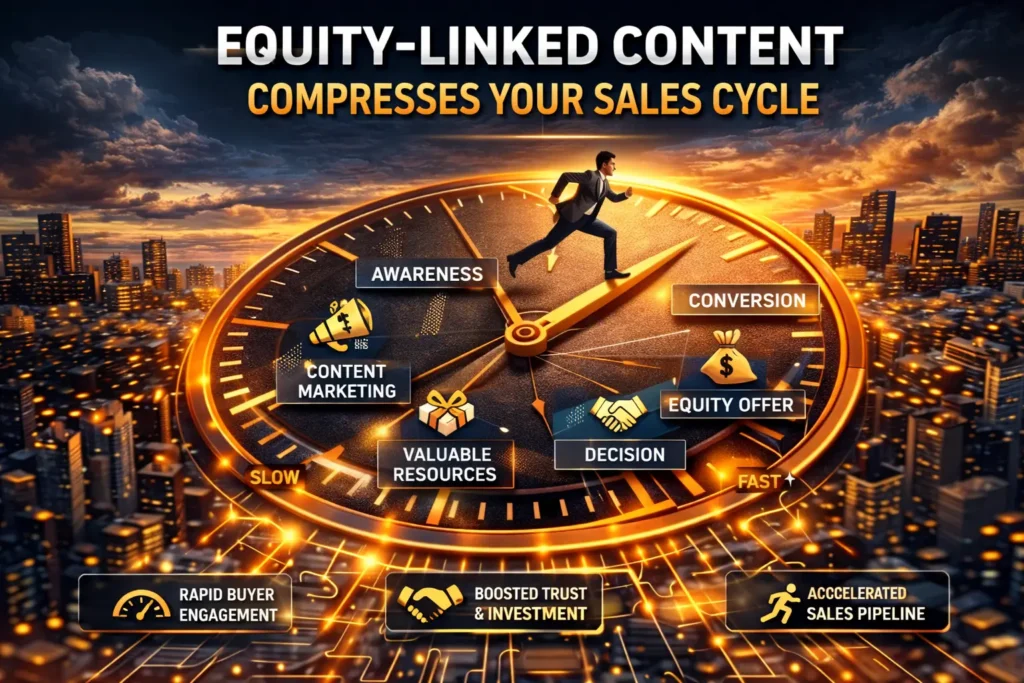
Stock marketing is not just for raising capital. It directly accelerates enterprise sales, and this is where technical founders leave the most money on the table.
When a prospect’s procurement team Googles your company before signing a $200K contract, what do they find? If the answer is a thin press release and a sparse LinkedIn page, you lose deals to incumbents with worse products. Stock marketing floods that search surface with signals that compress trust — funding announcements with embedded traction metrics, founder interviews that cite customer outcomes, technical blog posts that reference your valuation trajectory.
Stripe executed this better than almost anyone at the growth stage. Every piece of content Stripe published between 2015 and 2018 — developer documentation, engineering blog posts, conference talks — carried an implicit signal: this company is building something durable. That signal is stock marketing at the content layer. It did not close deals directly, but it eliminated the hesitation that kills deals.
The data backs this up. Gartner’s 2023 B2B buying research found that enterprise buyers who encountered “financial credibility signals” (funding context, growth metrics, investor names) during discovery were 31% more likely to advance a deal to legal review. Your stock marketing strategy builds those signals deliberately rather than accidentally.
For technical founders, the activation path is concrete: publish your architecture decisions with scale context, reference your customer retention metrics in engineering hiring posts, and let your Series A announcement do more work than a one-day news cycle.
Stock Marketing Recruits Engineers Faster Than Compensation Packages Alone

Recruiting at Series A is a stock marketing problem disguised as an HR problem. Every senior engineer you want to hire already earns market rate somewhere. The variable is perceived equity upside — and perceived upside is a marketing function, not a finance function.
Stock marketing at the talent layer means controlling the narrative around your equity story before a candidate ever speaks to your recruiter. It means your engineering blog posts reference your ARR growth so candidates can run their own math. It means your founder does podcast appearances that discuss the problem space’s TAM. It means your LinkedIn company page looks like a company mid-flight, not mid-launch.
Figma understood this early. Before it became a design industry standard, Figma’s technical blog posts read like a masterclass in ambitious infrastructure thinking. Engineers who read those posts did not just learn about WebGL — they absorbed a growth signal. That is deliberate stock marketing targeted at the talent market.
The speed advantage compounds quickly. If stock marketing cuts your average senior engineer hire from 90 days to 60 days, and you make 10 hires in year one, you recovered 300 engineering days of output. At a fully-loaded cost of $500/day per senior engineer, that is $150K in recovered capacity — from content strategy.
The mechanism is straightforward: candidates research you before they respond to a recruiter. Stock marketing ensures what they find converts their interest into urgency.
Building a Stock Marketing System That Compounds

One-off press releases do not constitute stock marketing. What compounds is a system — a repeatable process that ties your business milestones to narrative outputs across investor, customer, and talent audiences simultaneously.
The architecture of a working stock marketing system at Series A has four components:
Milestone triggers. Every material business event — a customer logo, a revenue threshold, a product launch, a key hire — triggers a content output. Not a tweet. A structured narrative artifact that can travel across LinkedIn, investor newsletters, and industry press simultaneously.
Metric layering. Every public-facing asset carries at least one growth metric. Not vague claims — specific numbers. “We process 4 million API calls per day” outperforms “we’re growing fast” in both credibility and search surface.
Equity signal amplification. Your investors, advisors, and customers all have audiences. Stock marketing systems build the flywheel: you create the asset, you distribute it to your network, your network amplifies it. Notion’s team built this deliberately with their product launch posts — every release was engineered to be shareable by their angel investors.
Cadence discipline. Stock marketing systems run on calendar rhythm, not inspiration. Monthly investor updates published on a fixed schedule. Quarterly founder essays tied to industry trends. Annual state-of-the-business pieces that serve as evergreen recruiting and sales assets. The cadence builds audience expectations that compound over time.
The measurement framework is not complicated: track inbound investor intros generated per quarter, monitor time-to-close on enterprise deals, measure time-to-hire on senior roles. If those three numbers improve as your stock marketing volume increases, the system is working.
Carta, the cap table management platform, scaled from Series A to a $7.4B valuation in part because its founders treated equity education content as a stock marketing lever — every blog post about option pools and 409A valuations positioned the company as the authoritative voice in a market it was simultaneously building.
The Compounding Machine You Build Today Closes Your Series B Tomorrow

Stock marketing is not brand awareness — it is systematic narrative control that compresses capital costs, sales cycles, and recruiting timelines simultaneously. The founders who treat it as a core operational system at Series A do not scramble to tell their story at Series B — that story already exists in the market, waiting to be confirmed.
Start with one milestone, one metric, and one audience. Build the system around that, and let the compounding do the rest.
Written by rahuldigi.com